
Searching Lowndes County Criminal Dockets
Start with the county's Electronic Court Offerings page. It separates Lowndes Odyssey Public Access from the filing and payment tools. Odyssey is the local route for supported Superior and State Court case, party, calendar, judgment, order, and register-of-actions information. Pick Superior Court for a felony. Send misdemeanor and county traffic matters to State Court. Open the portal in a live browser. That confirms current labels, image fees, and guest permissions. A case number works best. Searching by name alone means matching the displayed format and checking the party role. The Magistrate instructions call for a last-name wildcard followed by a first-name wildcard. That rule may not hold in every division, so treat it with care.
- Identify Superior, State, Magistrate, Juvenile, city, or federal court.
- Open the official portal and select the matching division.
- Search by full case number or the displayed name format.
- Compare court, filing date, status, charges, and settings.
- Ask the proper clerk to resolve conflicts or certify a record.
If Odyssey comes up empty, ResearchGA is the broader Georgia provider route. It may require an account. After that, go to the clerk directly. Visit 327 N Ashley Street. Call 229-333-5127. Or mail a precise request to PO Box 1349, Valdosta, GA 31603. Ask about a courthouse public terminal and document images too.
Lowndes Criminal Docket Court Routing
Sort out venue before any name search. Felonies live in Lowndes Superior Court. Lowndes State Court handles misdemeanors and county traffic cases. Through its own clerk, Magistrate Court runs warrants, bond hearings, first appearances, and preliminary hearings. City ordinance and traffic cases stay with the issuing city. Federal prosecutions go through PACER and the Middle District of Georgia, never Odyssey.
| Court | Work | Start |
|---|---|---|
| Superior | Felonies | Odyssey or main clerk |
| State | Misdemeanors | Odyssey or State clerk |
| Magistrate | Warrants and bonds | Separate portal or clerk |
| Municipal | City cases | Issuing city |
| Federal | Federal offenses | PACER |
A blank result can mean several things. The court could be wrong, indexing may lag, the file is older, it is a city case, or access is restricted. None of that proves no case exists.
Inside a Lowndes Criminal Docket
Each piece of a docket answers a different question. The register is a dated index of case activity. A document image is the filing behind an entry. A calendar lists planned events, and a payment record shows a transaction that may not show the disposition.
| Case number | The court identifier, including prefix, year, punctuation, and zeroes: [court]-[year]-[number]. |
|---|---|
| Charge | An alleged offense, not a conviction. |
| Entry date | When the clerk received or posted an event. |
| Setting | Arraignment, motion, pretrial, or trial date. |
| Disposition | The exact recorded outcome label. |
| Order | A judge's directive, sometimes requiring a copy request. |
The official 2025 non-jury calendar confirms the fields you will see, including docket number, file date, attorney, hearing type, start time, comments, charge, and arraignment. It is useful for understanding layout, but private names should not be republished from it.
Lowndes Criminal Calendar Snapshots
The Court Calendars index publishes monthly and special State Court schedules. That can confirm a planned Lowndes criminal docket setting. It cannot prove a hearing happened. Nor can it prove a case ended. A continuance or order may change the schedule after the PDF is posted.
- Arraignment
- A formal appearance for plea and advisement.
- Calendar call
- A session to assess readiness, pleas, motions, or trial.
- Non-jury trial
- A trial heard by a judge.
- Disposition
- The resolution, not a charge or setting.
Spot a conflict? Call the clerk. For State citation questions, use 229-671-3320 or 229-671-3325, and the FAQ sends non-jury and jury date questions to the Solicitor at 229-671-2510. Remember, a calendar listing is a scheduled event, not proof of guilt or a final criminal disposition.
How a Criminal Case Moves
Details vary. Still, a criminal docket follows a clear sequence. A Magistrate event may come before the Superior or State case. Later entries can record charges, counsel, motions, settings, pleas, orders, and disposition. Read the docket in date order, since one status line rarely tells the full story.
Docket flow: Filing › Arraignment › Pretrial › Plea or Trial › Disposition › Sentencing
Some cautions apply when reading entries. A motion is a request, not a ruling. A charge is only an allegation. A continuance does not dismiss anything. A probation or DUI Court event may not be the final result either. When exact legal effect matters, read the signed order or seek a certified disposition.
Lowndes DUI Court Docket Path
Lowndes also runs a problem-solving DUI Court. The official DUI Court page gathers schedules, entry materials, forms, and program links. It is not the general misdemeanor register. Nor is it a ticket screen. The official page shows how this specialty activity sits beside the main Lowndes criminal docket.
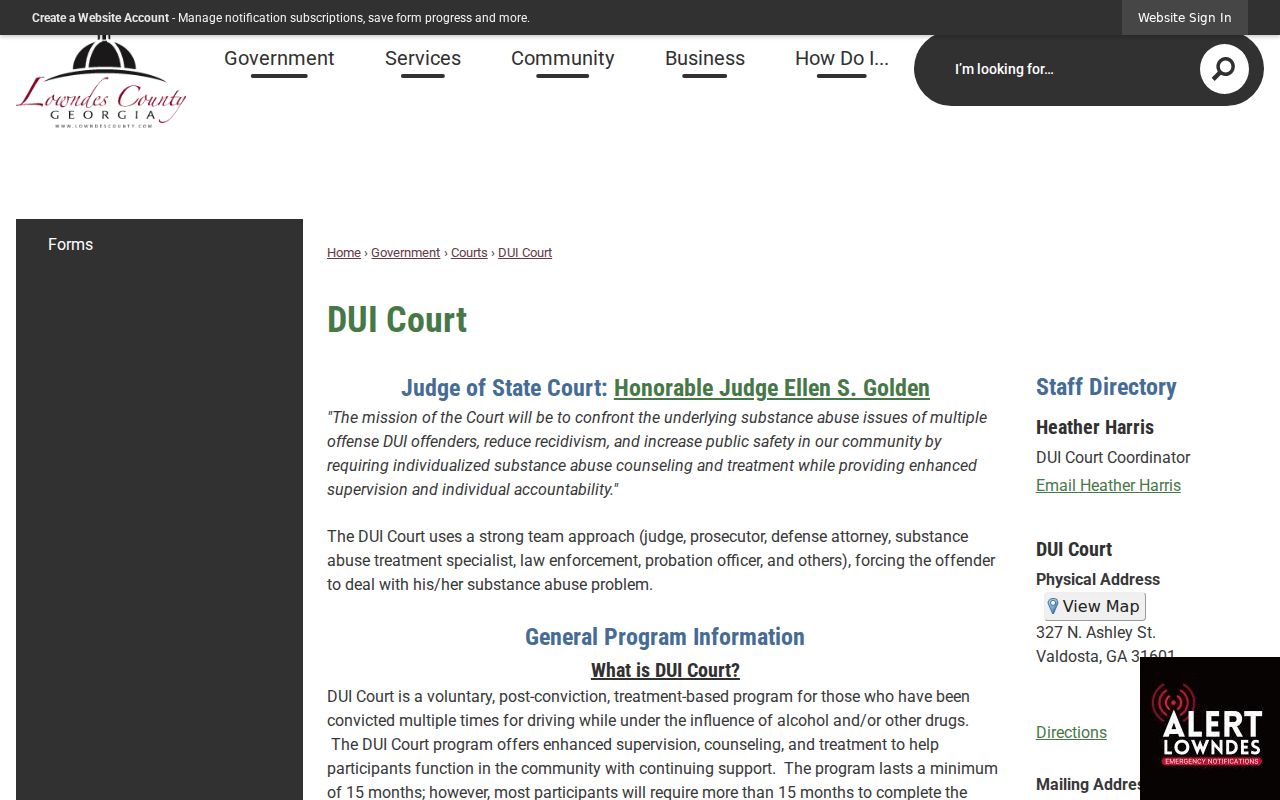
Use that page for program material. Then turn to the State Court register or the clerk for the underlying case history. Program participation, a single event, and final case status are three separate facts.
Courts That Hold Criminal Dockets
The shared Clerk of Superior Court office is your main contact for felony records. It also handles State misdemeanor records. Beth Greene is the listed Clerk, and the main number is 229-333-5127. State criminal services sit on the first floor. Magistrate keeps a separate second-floor clerk at the same address. That office uses 229-671-2610. The State Court page pulls together clerk, citation, calendar, and FAQ routes.
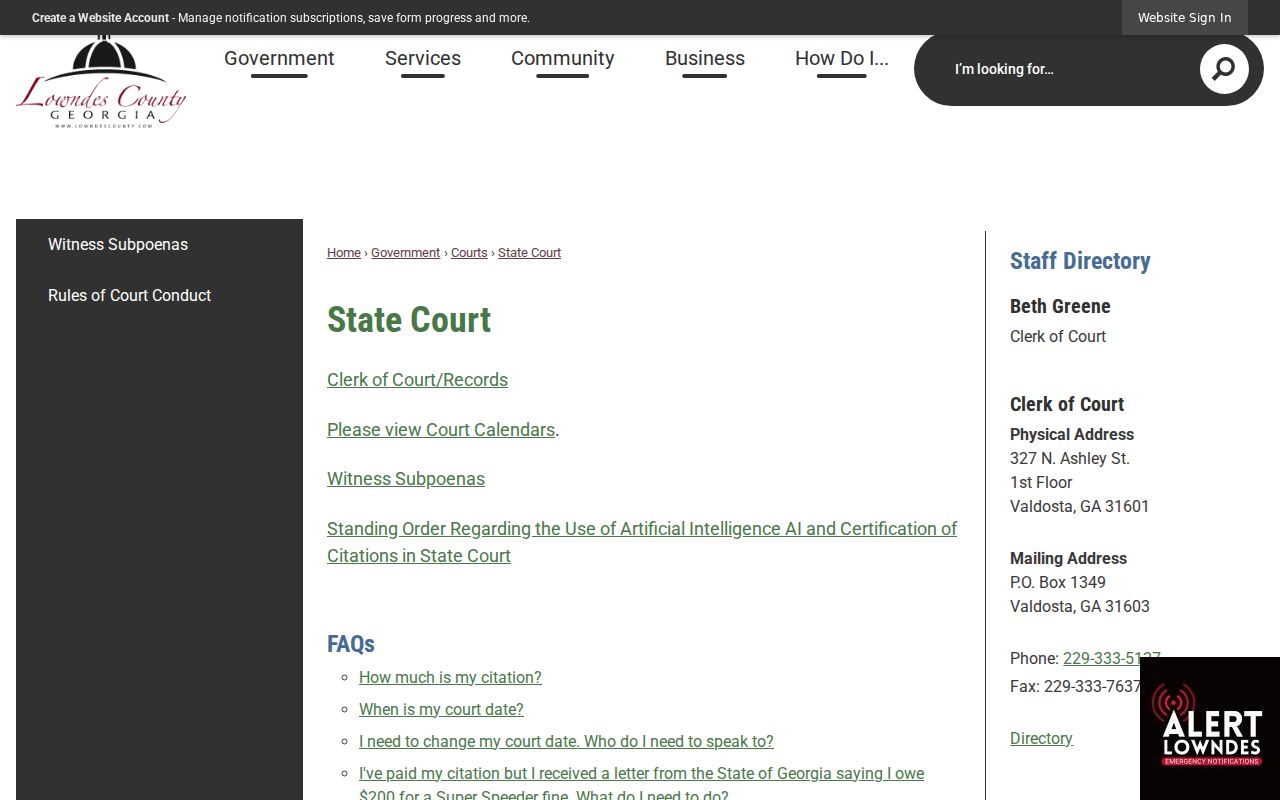
That page routes users, while Odyssey holds the actual register. For current dates, try the calendar, citation clerk, Solicitor, or a signed notice. City citations must be checked with the issuing city.
Lowndes Certified Criminal Dispositions
A portal printout is not a certified record. The State Court FAQ offers a mail route instead. Send the details that official process requires, including identifying information, the citation number if known, a contact phone, a return address, and the fee, to PO Box 1349, Valdosta, GA 31603. Sensitive identifiers belong in the direct request only. Keep them out of any public copy.
The stated minimum is $7.50 per case, with three to five business days allowed. Two cases cost $15. Two certified copies of one case also cost $15. Confirm the amount before mailing, and call the Clerk about Superior criminal copy fees, since that court posts no complete current schedule.
Sealed Dockets and Public Access
Georgia court records are generally open. A law, rule, or court order can limit access. Uniform Superior Court Rule 21 governs restriction and redaction. Public access still does not permit republication of protected identifiers.
Key rule: Juvenile matters are a separate access class. The Attorney General's juvenile-record opinion discusses statutory confidentiality. A County Open Records Act request cannot override a seal or juvenile rule.
An empty result does not mean the case is gone or dismissed. Ask the right clerk about a public index. Clerks can explain the access procedure. Staff supply records and process details, not legal advice.
Lowndes Criminal Search Boundaries
Each online tool answers a different question. eFileGA submits filings. It is not public Odyssey access. ResearchGA supports broader discovery. It does not prove every Lowndes docket is present. A payment vendor shows payment, not the full outcome. County-government records requests are a separate track entirely.
For direction, the County Clerk routes criminal court records to the Clerk of Superior Court. Turn to the County Clerk for executive records, not to bypass court rules. Federal matters run through PACER. City matters belong to the city court.
Portal coverage has edges too. Older paper files and the newest filings can both fall outside the visible window. When you contact the clerk, be specific. Give the court name, case number if known, filing year, record type, and the format you want. Ask whether inspection, an electronic copy, a plain paper copy, or certification is available. Precise requests lower the odds of landing in the wrong division. They also help staff tell a docket entry apart from the document behind it.
Keep a simple log for your own case tracking. Keep the details tight. Note the court, the case number, the source, the last visible entry, the next setting, and any clerk confirmation. That record pays off. It makes a stale calendar, a transferred case, or an entry needing certification easy to spot.