
Getting Lowndes County Court Records
The court matters more than the party name when you start. The Lowndes County Clerk of Superior Court holds Superior Court felony, civil, and domestic-relations files. The office also keeps State Court misdemeanor, traffic, and civil cases. The county's local Odyssey Public Access system can display party and case data, calendars, judgments, orders, and a register of actions. That register lists filings and events by date. It rarely shows every document. For Odyssey access, use the Electronic Court Offerings page. ResearchGA offers a broader account-based Georgia search. In person, go to the first-floor counter at 327 N Ashley Street, call 229-333-5127, or mail a precise request to PO Box 1349, Valdosta, GA 31603. Ask too whether a public terminal holds images missing from the web. Magistrate records sit in the second-floor office at 229-671-2610. Probate and Juvenile requests run through separate offices of their own.
- Identify the court and record type.
- Gather the case number, party name, and filing date.
- Check Odyssey or ResearchGA.
- Call the correct clerk if a result is absent.
- Request a plain or certified copy.
Lowndes Court Clerks Split Records
No single counter holds every Lowndes County court record. Beth Greene's office is the shared route for Superior and State Court files. Magistrate Court keeps lower-dollar civil, dispossessory, warrant, bond, and preliminary matters. Probate handles estates and guardianships. Juvenile files carry special limits, and municipal clerks keep the city cases.
| Matter | Custodian | Route |
|---|---|---|
| Felony, broad civil, domestic | Superior clerk | Odyssey or first floor |
| Misdemeanor, county traffic | State Court/shared clerk | Odyssey or clerk |
| Small claims, dispossessory | Magistrate clerk | Portal or second floor |
| Estate | Probate Court | Estate form |
| City citation | Municipal court | City clerk |
The County Clerk's open-records office sends criminal, civil, divorce, and custody requests back to the Clerk of Superior Court.
Court Record Types
Court records in Lowndes County run from a bare index line to a full document file. Some records hold only that index line. Others hold a full file. Public files may hold complaints, indictments, answers, motions, notices, service returns, orders, judgments, dispositions, and calendars. Magistrate cases can add claims, dispossessory filings, warrants, and hearing entries. Probate records may involve an estate, a will, or an inventory. They may also cover a guardianship or conservatorship. The official 2025 Probate handout lays out the separate Probate path.
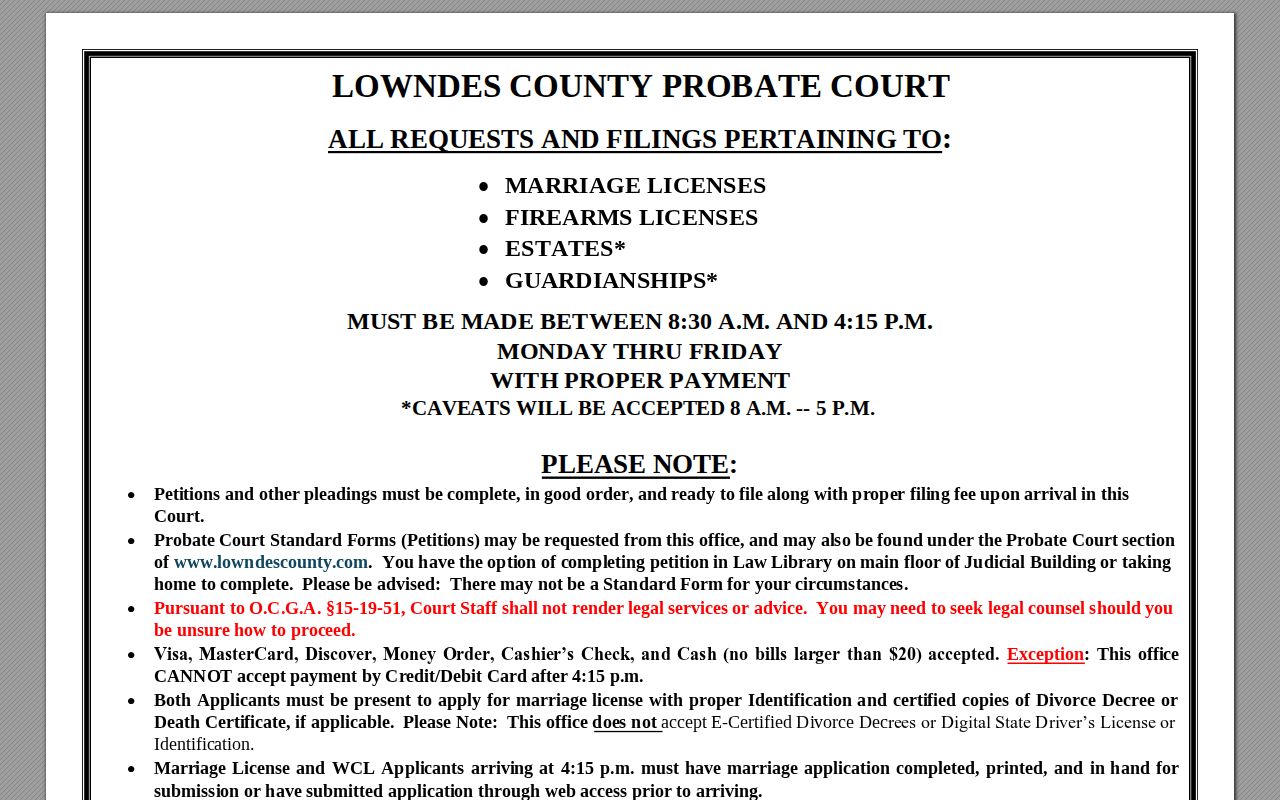
That separate office and its own form set explain why Odyssey cannot cover every Lowndes County court record.
County Form Is Not Court Access
The Georgia Open Records Act covers county-government files. It does not cover court files. Georgia's Attorney General says courts generally sit outside the Act's agency procedure. So a docket request goes straight to the clerk. That clerk keeps the case. Keep the County Clerk form for administrative records, and never use it to work around a court restriction. The county open-records form shows fields for inspection, copies, fees, and timing.
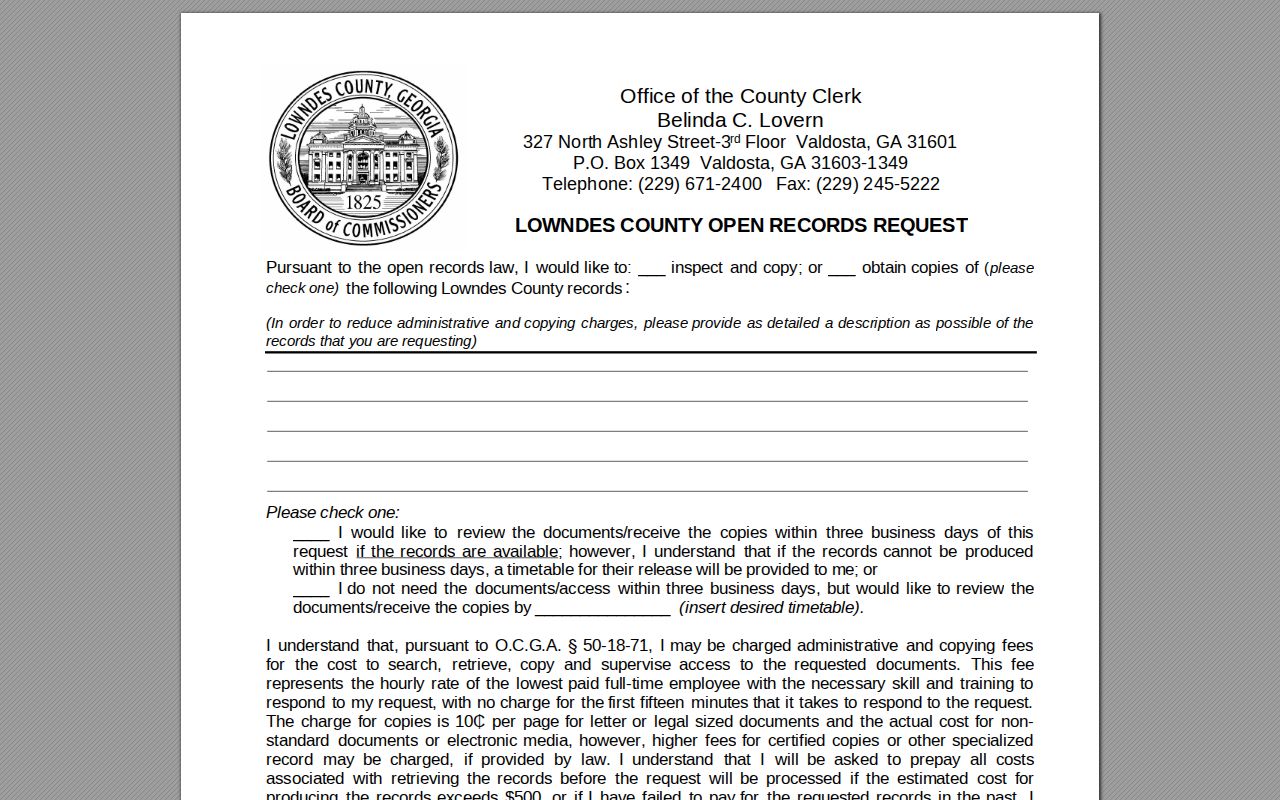
The county form has a limit: court pleadings and dockets must still go through the proper court clerk.
Inside a Lowndes County Court Record
A Lowndes County court record shows what was filed and what the court did on each item. Read it with care. A charge or a claim is never a result. It is only an allegation. A calendar setting only plans a hearing. It is not proof the hearing took place. The final order or disposition is the better place to see the true outcome, though later filings can still matter to the case.
| Case number | The court's unique file reference. |
|---|---|
| Register of actions | Dated filing, notice, setting, and order entries. |
| Party and counsel | Public names, roles, and attorneys. |
| Settings | Hearing type, date, time, and place. |
| Disposition | The recorded judgment, plea, dismissal, or result. |
Odyssey sometimes lists an index entry with no images attached. Ask the clerk for a filing by date and title. The Lowndes County case lookup can find the file number first.
Lowndes Probate Uses a Form
Lowndes County probate estate research runs through a set form. It skips the general docket portal. You supply the estate name. Add the case number if you know it, the date of death if known, and your own requester details. The examination fee is $10 per estate, and copies cost extra. Call for current copy prices. The official estate search form shows those fields on one page.
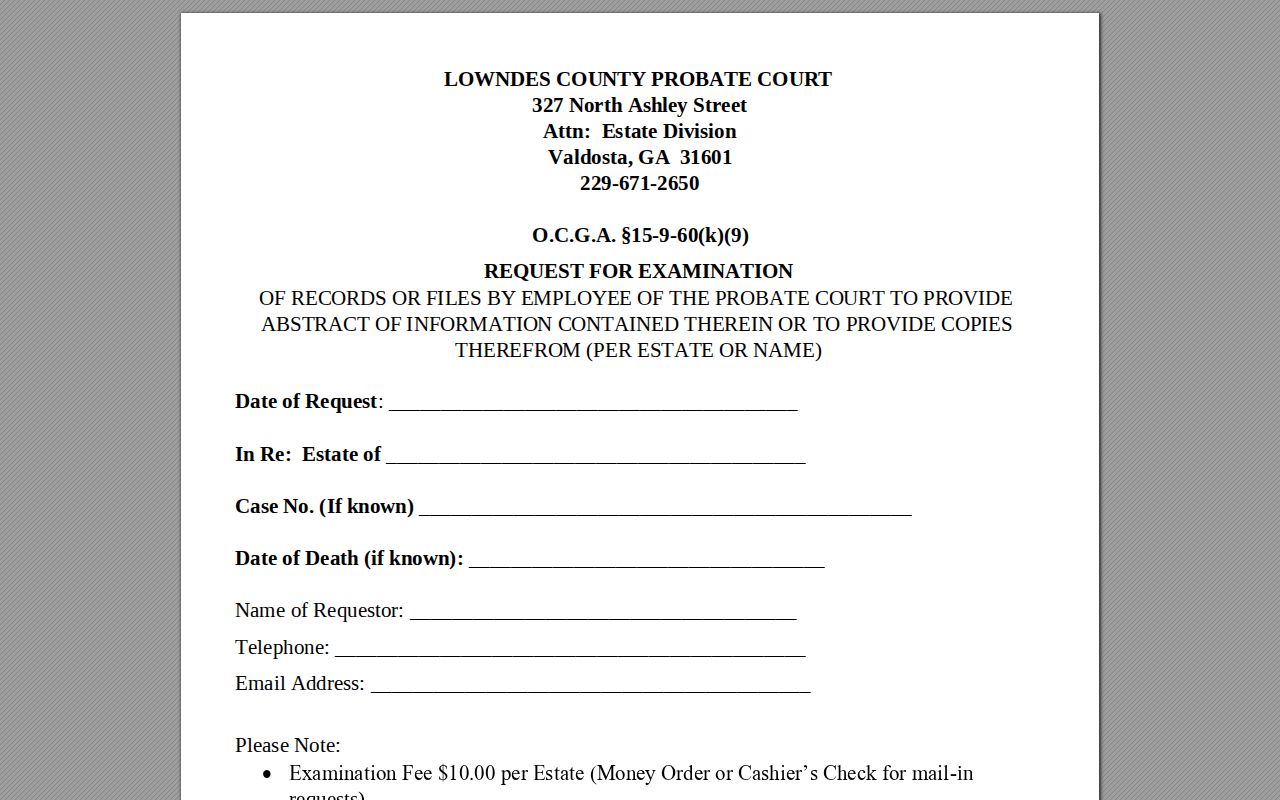
The form shows estate examination is a Probate service, and sensitive Probate records can carry different access rules.
Fees and Certified Copies
A plain copy just reproduces the record. A certified copy carries the clerk's attestation and seal, which is often what an official use demands. Ask which form you need before you pay. The clerk can quote current copy fees for Superior and State Court cases by phone.
| Service | Amount |
|---|---|
| State certified disposition | $7.50 minimum per case |
| Two State cases | $15 |
| Two certified copies, one case | $15 |
| Magistrate office copy | $0.50 per copy |
| Probate estate examination | $10, copies extra |
A mailed request for a State Court certified disposition needs full case details and three to five business days. Confirm payment and return-mail arrangements. Remember that eFileGA handles filings, not copy orders.
Lowndes County Clerk of Superior Court
327 N Ashley Street, first floor
Valdosta, GA 31601
229-333-5127
Sealed Records and Public Access
Juvenile matters, sealed cases, protected data, and some Probate or domestic filings may be withheld or redacted. A blank search proves nothing. The record could sit in another court, be too old for online coverage, be newly filed, be sealed, or simply be indexed under a different name.
Georgia court rule: Uniform Superior Court Rule 21 governs access, restriction motions, and protected data.
Start with the clerk when a Lowndes County case seems sealed. A county open-records request cannot undo a sealing order. Georgia's judicial-security process shields certain personal data. It is not a sweeping tool for pulling whole cases out of public view.
Sometimes a docket result shows up online with parts blacked out. Request only the public portion. Ask the clerk whether a written order restricts the rest. Staff can walk you through the access process. What they cannot do is give legal advice or guess at a judge's reasons. Going beyond the public portion usually means filing a motion with the court. One more caution. A missing name, a hidden image, or a trimmed entry never proves the event itself did not happen.
Archived paper files are a different chore. Ask about search and copy costs before the clerk starts pulling boxes. For genealogy or historical digging, bring an approximate year. Include the court and likely party spellings. Digital name indexes may not reach back across the full life of a Lowndes County case file.
Federal Records Use Valdosta PACER
Federal cases never show up in county Odyssey. The Middle District of Georgia handles Lowndes matters from Valdosta, and bankruptcy runs through its own federal court. Both systems live on PACER and CM/ECF. The federal Valdosta office lists the division's contact details and courtroom information for that separate route.
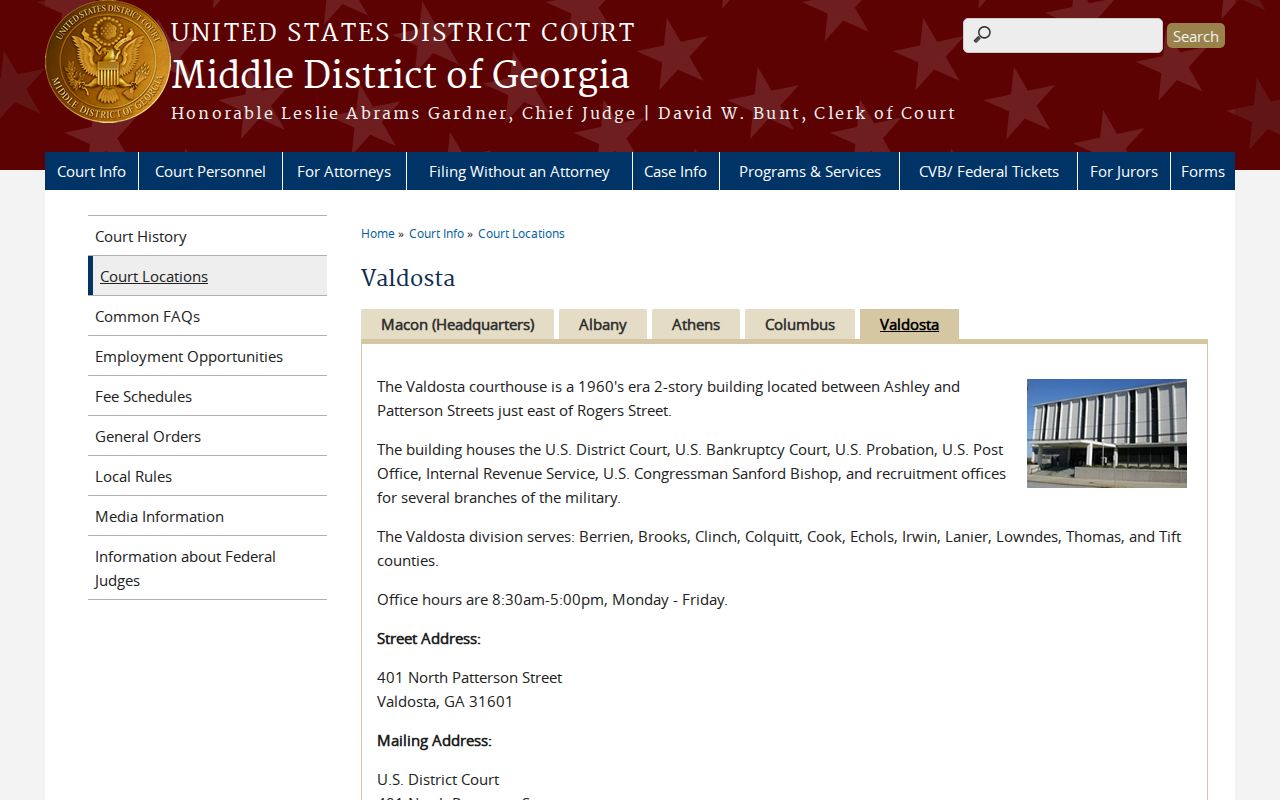
This court has a different jurisdiction and custodian.
PACER provides federal docket access.
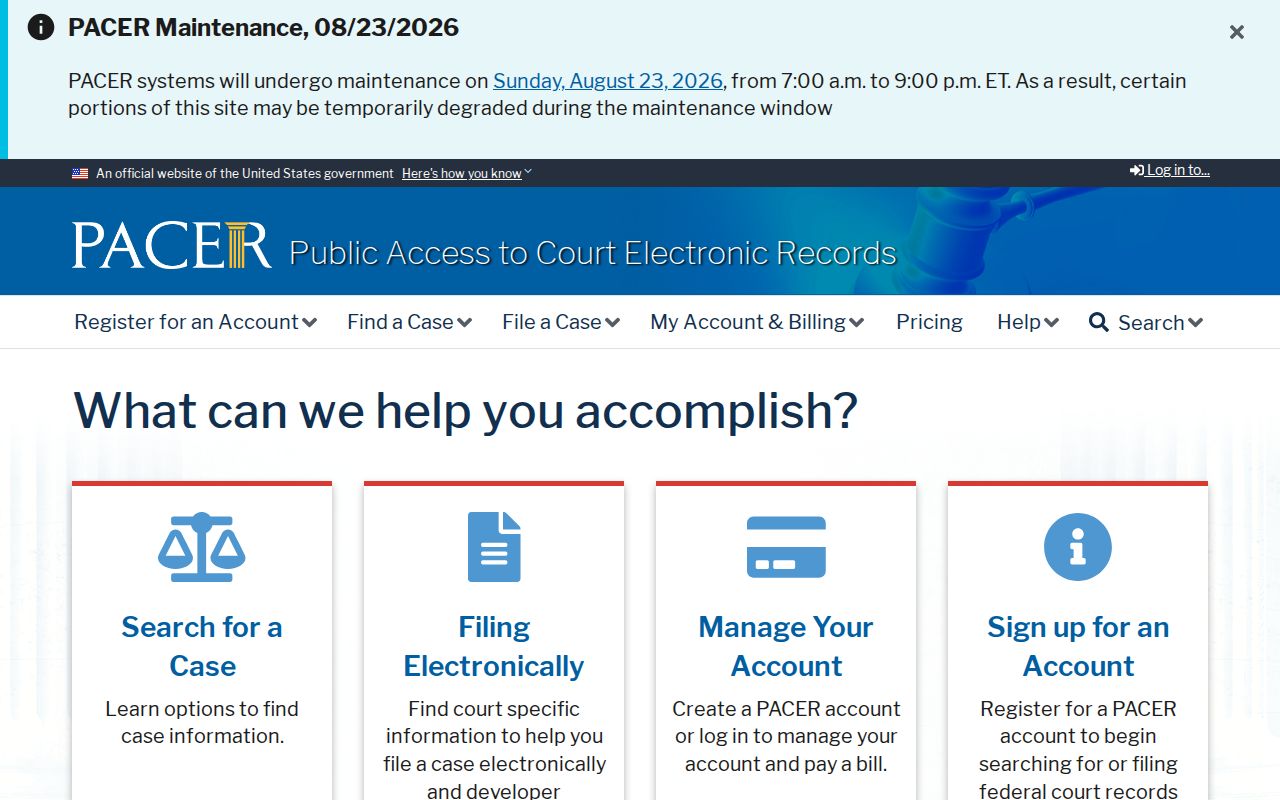
PACER requires registration and can charge for pages.
Federal Record Fees Differ
Federal record fees come from the national PACER schedule, not from Lowndes clerk fees. What you pay at a courthouse terminal, and any exemptions, can differ from online billing. Check the pricing before opening a long docket. The PACER pricing page lists the current per-page rates. Fee caps, audio charges, and billing rules appear there too.
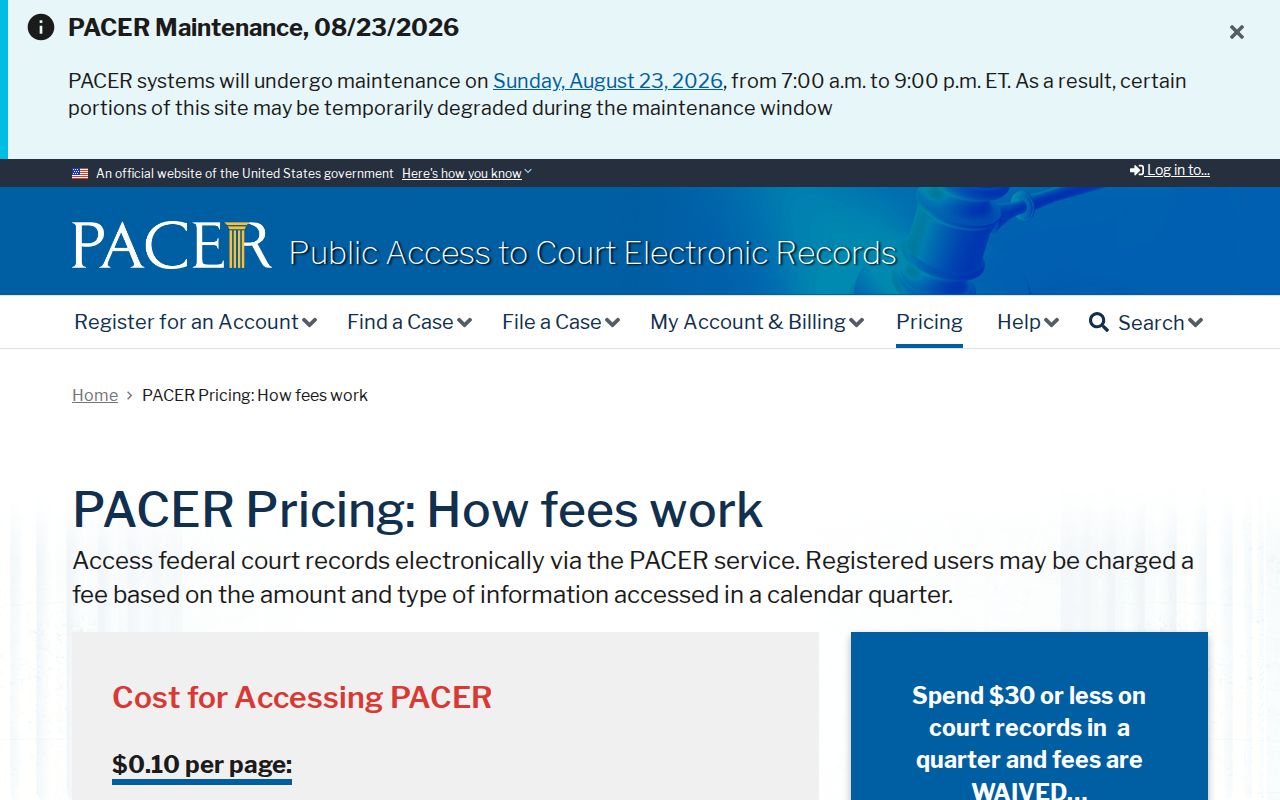
That fee split points back to step one. Know which court you are asking before requesting anything.
A solid Lowndes County record request names one existing item. It does not ask staff to build a report from scratch. Include the court, the case number, the document title, the filing date, and the format you want. No case number? Offer a narrow name and year range instead. Say whether inspection alone would satisfy you. Those details help the clerk. Staff can then tell a docket sheet apart from a pleading, order, judgment, calendar, or certified disposition.
Before trusting a copy, match its case number and court caption against your search result. Look at the final page for a signature, filing stamp, or certification block. Did an appeal come later? Search the Georgia Court of Appeals or the Supreme Court of Georgia on its own. The appellate docket stays separate from the Lowndes County trial record. That holds even when both concern the same dispute.